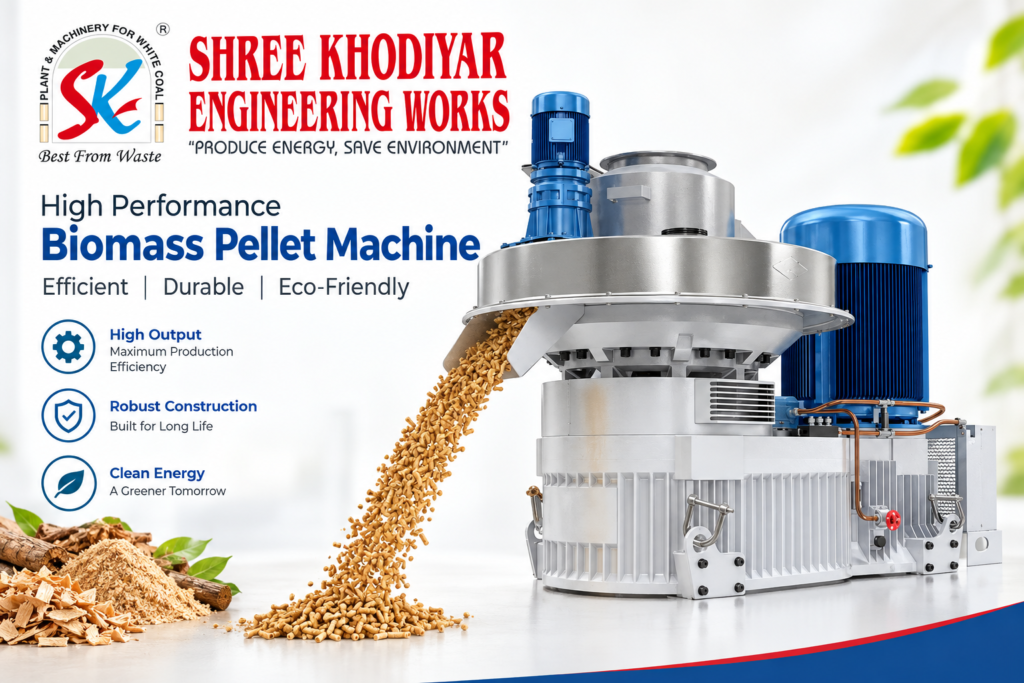
A high-capacity biomass pelleting plant designed for large-scale, continuous industrial operation. The system converts agricultural and biomass waste into uniform fuel pellets and includes an integrated hammer mill for raw material size reduction, along with input and output conveyors for automated material handling.
Shree Khodiyar Engineering Works, Rajkot, Gujarat, India
Included Equipment
Biomass Pellet Machine 6-8mm
Working Mechanism
Pellet Machine — Main motor, gear reducer, auto lubrication system, oil & grease pumps, pelleting die & rollers, and a cooling system for finished pellets; dust collectors control airborne particulate during operation.
Hammer Mill — High-efficiency blower, screw conveyor, and rotary air valve work together to reduce raw biomass to the fine size required for pelleting.
Material Flow — Raw biomass is fed via the input screw conveyor, size-reduced in the hammer mill, compacted into cylindrical pellets by the pellet machine’s rollers and die, cooled, and discharged via the output belt conveyor.
Production Capacity
Pellet Machine Output
1,500 – 2,000 Kg/hr ± 10% (depends on raw material density & moisture)
General Specifications
Feeding Raw Material Size
Less than 6 mm
Moisture Content of Raw Material
Up to 10%
Pellet Diameter
8 mm & 10 mm (cylindrical, dependent on pellet die)
Electrical Power Requirement — Overall Plant
Total Power Connection
189 HP / 141 KW
Total Ampere Load
160 – 170 A
Power Consumption
70 – 75 Units/hr
Overall Supply
415 Volts ± 10%
Motors — Pellet Machine
Main Motor
132 KW (177 HP)
Land & Manpower Requirement
Total Land Required
1,500 – 2,000 Sq. Mt. (approx.)
Key Features
RPM controller
Easy to change wear & tear parts
Fully automatic control panel
Robust design built for continuous industrial operation
In-house manufacturing — designed, fabricated and trial-run at the Rajkot works
Branded motors, gearboxes and bearings used throughout