

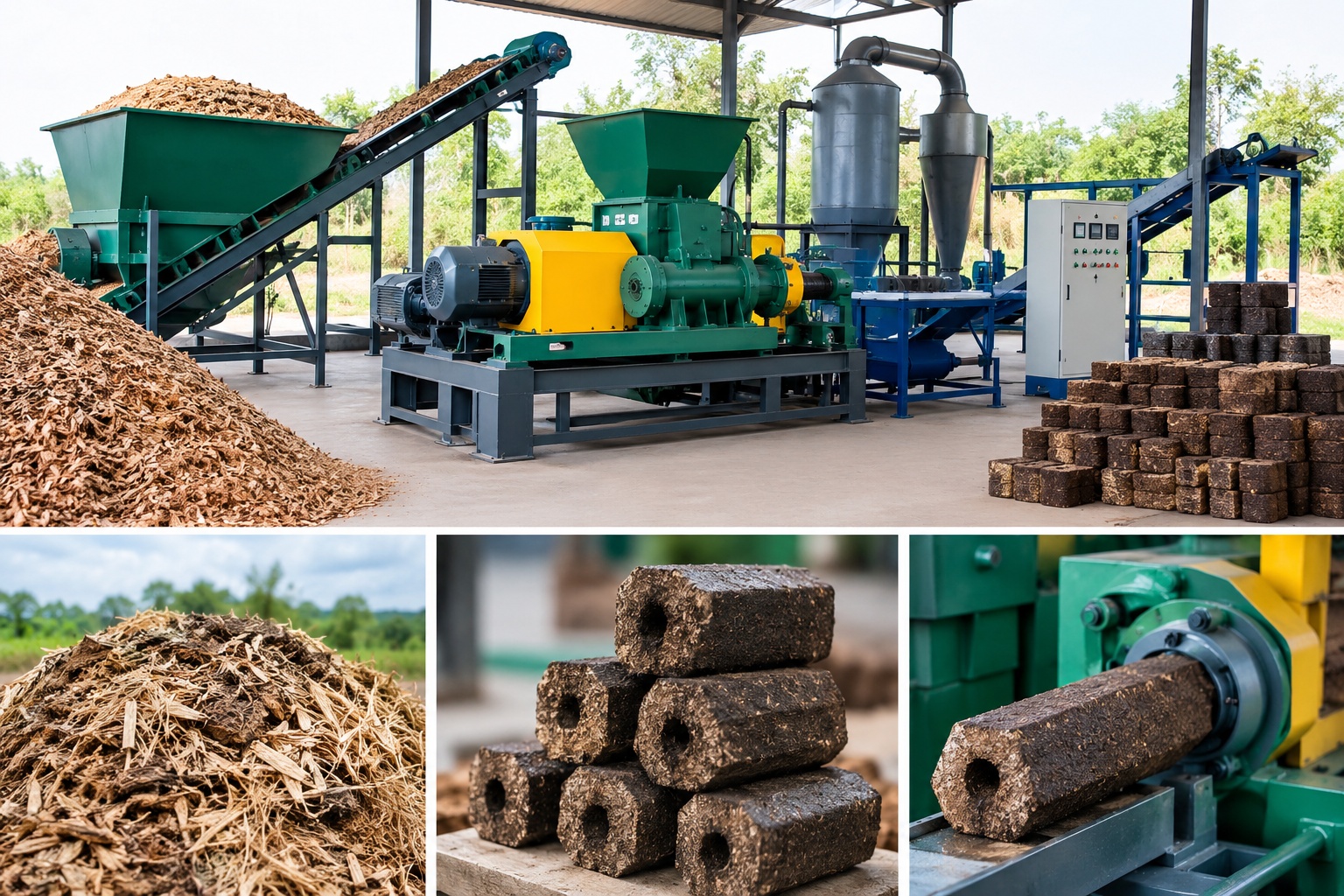
The cost of setting up a biomass briquetting plant in India depends on production capacity, machinery selection, raw material availability, land, electrical infrastructure, drying requirements, labour, storage, and transportation. A proper project estimate should therefore be prepared after deciding the required production capacity and checking the available biomass.
For anyone researching how to set up a biomass briquetting plant, the main investment areas are machinery, site development, electrical installation, raw-material handling, storage, labour, utilities, maintenance, and working capital. A well-planned biomass briquette manufacturing plant should also be designed around the type and moisture content of the raw material available locally.
For businesses in Rajkot, India, sourcing agricultural and other suitable biomass residues locally can be an important part of plant planning. The availability, quality, seasonality, and transportation cost of raw material can directly affect production economics.
What are the main costs of a biomass briquetting plant?
There is no single standard cost for every biomass briquetting project. Two plants with similar production capacities can have different investment requirements because their machinery configuration, land, raw materials, automation, and infrastructure may differ.
The main cost categories include:
Cost category | What it may include |
Land and site | Land, leveling, roads, and basic site development |
Building | Production shed, storage area, and office space |
Machinery | Briquetting machine, grinder, dryer, conveyors and related equipment |
Electrical setup | Electrical panels, wiring, cables and installation |
Raw materials | Initial biomass stock and working inventory |
Storage | Raw-material and finished-briquette storage |
Labour | Machine operators, helpers, supervisors and maintenance staff |
Utilities | Electricity, water and other plant requirements |
Transportation | Raw-material collection and finished-product delivery |
Maintenance | Spare parts, servicing and machine maintenance |
Working capital | Funds required for regular day-to-day operations |
This approach gives business owners a more realistic picture than looking only at the purchase price of the briquetting machine.
How to set up a biomass briquetting plant step by step?
Understanding how to set up a biomass briquetting plant starts with planning the complete production system rather than purchasing machinery first.
1. Study the local biomass supply
First, identify which biomass materials are consistently available near the proposed plant.
Potential feedstocks can include suitable agricultural and agro-processing residues such as:
- Sawdust
- Rice husk
- Groundnut shells
- Cotton residues
- Groundnut and other crop residues
- Sawing and wood-processing residues
- Other suitable dry agricultural waste
The exact feedstock should be evaluated for moisture, particle size, ash content, contamination, bulk density, and seasonal availability.
A cheap raw material is not necessarily a good raw material if it requires expensive transportation or extensive processing.
2. Decide the required production capacity
The next step is to determine how much briquette production is required per hour or per day.
Capacity should be based on:
- Expected customer demand
- Raw-material availability
- Working hours
- Available investment
- Storage capacity
- Power availability
- Future expansion plans
For example, a business may begin with a smaller production capacity and expand after establishing a reliable customer and raw-material network.
3. Select suitable biomass briquette plant machinery
Choosing biomass briquette plant machinery is one of the most important decisions in the project.
Depending on the raw material and plant design, equipment may include:
- Crusher or grinder
- Hammer mill, where required
- Dryer or drying system
- Feeding system
- Briquetting machine
- Conveyors
- Cooling and handling equipment
- Weighing and packing equipment
- Electrical control system
- Dust-control equipment
The machinery configuration should be selected after testing the actual raw material. This helps avoid buying equipment that is unsuitable for the feedstock.
India has domestic manufacturing capability for several types of biomass-energy equipment, including briquetting equipment, material-handling equipment and related systems.
4. Check raw-material moisture and particle size
Raw-material preparation has a major effect on production performance.
Material that is too wet may require drying before briquetting. Material that is too large may need crushing or grinding. The correct preparation requirements depend on the feedstock and machine specification.
This is why raw-material testing should be completed before finalizing the equipment configuration.
5. Plan the plant layout
A good plant layout should provide a logical movement of material from receiving to finished-product storage.
A basic flow can be:
Raw-material receiving → Storage → Size reduction → Drying → Feeding → Briquetting → Cooling/handling → Finished-product storage → Dispatch
The layout should provide sufficient space for:
- Raw-material unloading
- Machinery installation
- Operator movement
- Maintenance work
- Fire and safety access
- Finished-product storage
- Vehicle movement
Efficient layout planning can also reduce unnecessary material handling and improve day-to-day operations.
What machinery is required for a biomass briquetting plant?
The exact biomass briquette plant machinery depends on the feedstock and production capacity. A typical plant may require several connected systems rather than only one briquetting machine.
Briquetting machine
The briquetting machine compresses prepared biomass into dense briquettes. Machine selection should consider the feedstock, required output, briquette size, operating hours, and expected production conditions.
Crusher or grinder
A crusher or grinder reduces oversized material to a suitable particle size. Whether this equipment is required depends on the incoming biomass.
Drying system
If the feedstock has excessive moisture, a drying system may be necessary before briquetting. Drying requirements should be determined from actual moisture testing rather than using one fixed value for every material.
Feeding and conveying system
Conveyors and feeders help move biomass between different stages of the plant. A suitable feeding system can provide a more consistent supply to the briquetting machine.
Storage and handling equipment
Storage areas, conveyors, weighing systems, and packing equipment help manage both raw materials and finished briquettes.
What are the biomass briquetting plant requirements?
Before investing in a biomass briquette manufacturing plant, business owners should evaluate the following requirements:
- Suitable land and access: The site should allow raw-material and finished-product vehicles to move efficiently.
- Reliable raw materials: A consistent supply is essential for continuous production.
- Electricity: Power requirements should be confirmed with the selected machinery.
- Water and utilities: Determine the actual requirements of the equipment and site.
- Storage: Separate storage for incoming biomass and finished briquettes is useful.
- Machinery: Select equipment according to feedstock and production capacity.
- Labour: Operators and maintenance personnel may be required.
- Safety: Dust, heat, moving machinery, and fire risks should be addressed during plant design.
- Working capital: Funds are needed for raw materials, salaries, utilities, maintenance, and transportation.
- Market: Identify potential buyers before investing in a large production capacity.
How does the biomass briquetting process work?
The biomass briquetting process converts suitable biomass residues into a more compact solid fuel.
A simplified process is:
Raw-material collection → Inspection → Size reduction → Moisture management → Feeding → Briquetting → Cooling/handling → Storage → Dispatch
The exact process can vary depending on the feedstock and equipment.
For example, a material that already has suitable particle size and moisture may require less preparation than a wet or oversized agricultural residue.
The final product should be checked for consistency and suitability for its intended application.
What operating expenses should you consider?
The initial machinery investment is only one part of the total project cost. Operating expenses should be estimated before starting production.
Important recurring expenses include:
Raw-material cost
This can be one of the most important operating expenses. Consider not only the purchase price but also loading, unloading, transportation, storage losses and seasonal availability.
Electricity
Electricity consumption depends on the complete machinery configuration, production capacity and operating hours.
Labour
Budget for machine operators, helpers, supervisors, maintenance personnel and other required staff.
Maintenance and spare parts
Regular maintenance helps reduce unexpected downtime. The budget should include wear parts, lubrication, repairs, and periodic servicing.
Transportation
Transportation costs apply to both incoming biomass and outgoing briquettes. Locating a plant close to reliable raw-material sources and customers can improve logistics.
Packaging and handling
Depending on the customer’s requirements, additional costs may include weighing, packing, loading, and storage.
What factors can reduce the cost of setting up a briquetting plant?
Business owners can control some project costs through better planning.
Consider these steps:
- Select a site close to reliable biomass sources.
- Compare machinery based on total operating value, not only purchase price.
- Test raw materials before finalizing equipment.
- Avoid installing unnecessary equipment.
- Plan the plant layout before construction.
- Estimate electrical requirements early.
- Maintain adequate spare parts.
- Secure potential customers before scaling production.
- Keep sufficient working capital for the initial operating period.
The objective should not simply be to build the cheapest plant. The better goal is to build a plant that can operate reliably and produce briquettes economically.
Is financial assistance available for biomass briquetting plants in India?
Government support programmes can change over time, so businesses should verify the current eligibility, application status, and guidelines before including any subsidy in their project budget.
Under the MNRE Biomass Programme guidelines for the earlier National Bioenergy Programme Phase-I, briquette/pellet manufacturing plants were eligible for Central Financial Assistance of ₹9 lakh per MTPH, subject to a maximum of ₹45 lakh per plant.
However, the BioUrja portal currently states that applications for biomass briquette/pellet projects have been stopped until further notice while proposals are considered under the next phase and budget process. Therefore, businesses should not assume that this earlier assistance is currently available when calculating project costs.
For a new project, check the latest MNRE/BioUrja guidelines and applicable state-level requirements before making financial decisions.
How can SK Briquettes help with biomass briquetting?
Choosing the right equipment and planning the production line are important parts of starting a biomass briquetting plant business. SK Briquettes can be positioned as a resource for businesses evaluating biomass briquetting equipment, production requirements, and plant setup.
Before selecting machinery, discuss:
- Required production capacity
- Available biomass type
- Raw-material moisture and particle size
- Desired briquette specifications
- Power availability
- Plant layout
- Material-handling requirements
- Future capacity expansion
A machinery supplier should be able to explain how the proposed equipment matches the customer’s actual feedstock and production requirements.
For businesses planning a plant in Rajkot, India, local raw-material availability and transportation should also be included in the project assessment.
What should you check before investing in a biomass briquetting plant?
Before placing a machinery order, use this checklist:
- Confirm the target production capacity.
- Identify reliable biomass suppliers.
- Test the available raw material.
- Check moisture and particle size.
- Estimate annual raw-material availability.
- Compare machinery specifications.
- Calculate electricity requirements.
- Plan the plant layout.
- Estimate storage requirements.
- Calculate labour and maintenance expenses.
- Estimate transportation costs.
- Identify potential customers.
- Calculate working-capital requirements.
- Check current government and state requirements.
- Prepare a detailed project report before investment.
Frequently Asked Questions
1. How to set up a biomass briquetting plant?
To set up a biomass briquetting plant, first evaluate raw-material availability and production demand. Then select the capacity, test the biomass, choose suitable machinery, plan the site and utilities, install the production line, and establish storage, quality control, and sales processes.
2. What is required to set up a biomass briquetting plant?
A typical project requires suitable land, reliable biomass, machinery, electricity, storage, material-handling systems, labour, maintenance support, working capital, and a market for the finished briquettes.
3. What machinery is needed for a biomass briquette manufacturing plant?
Depending on the feedstock, machinery may include a crusher or grinder, drying system, feeder, briquetting machine, conveyors, cooling or handling equipment, weighing/packing equipment and electrical controls.
4. What is the cost of a biomass briquetting plant in India?
There is no single fixed cost. The investment depends on production capacity, machinery configuration, land, building, electrical infrastructure, raw-material preparation, storage, and working capital. A detailed project quotation should be prepared based on the specific plant requirements.
5. Is a biomass briquetting business profitable?
Profitability depends on raw-material cost, production efficiency, electricity, labour, transportation, briquette selling price, machine utilization and customer demand. A proper feasibility study should be completed before investing.
