
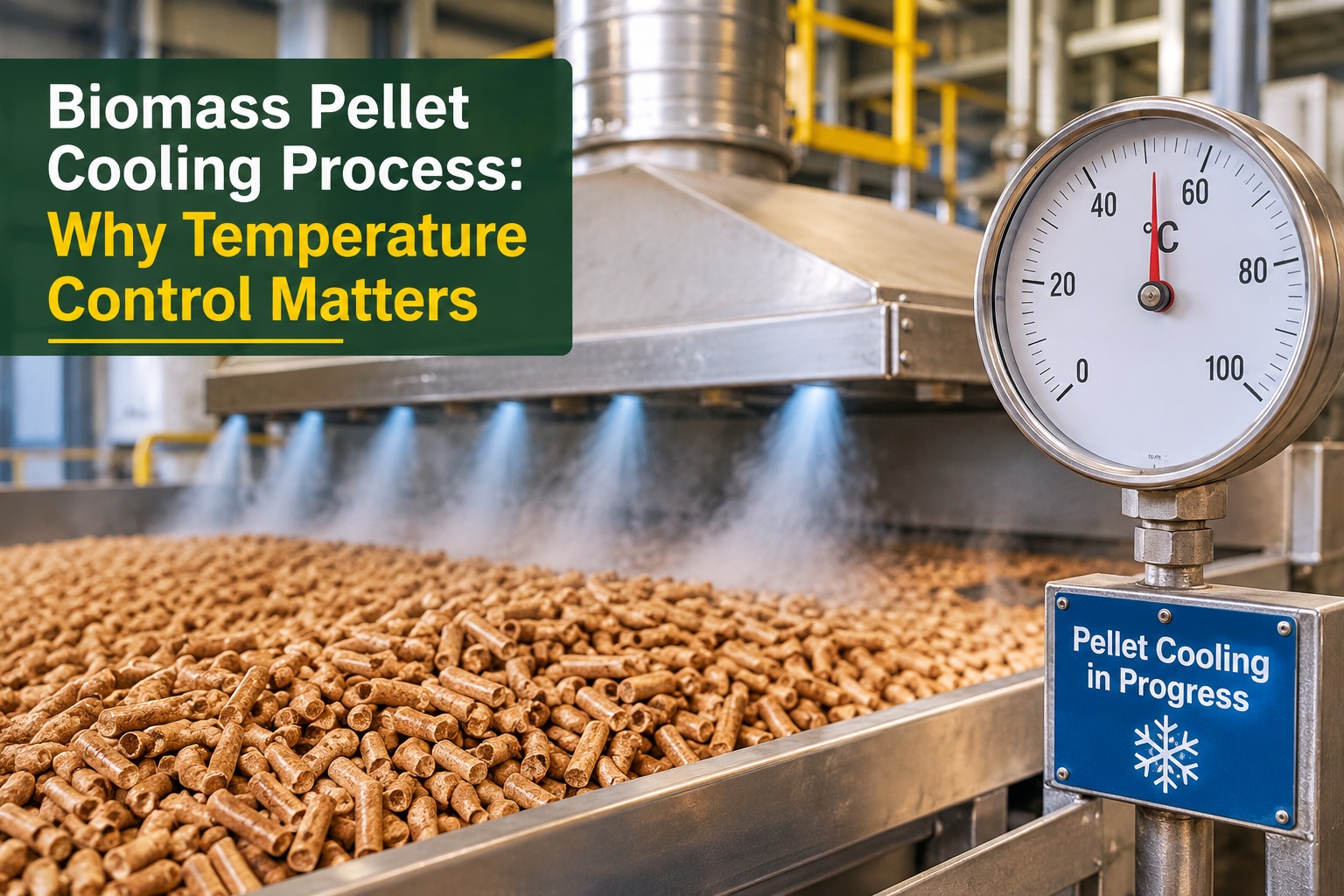
Biomass pellets come out of the pellet machine at a high temperature and need proper cooling before storage, packaging, and transportation. The biomass pellet cooling process reduces the temperature of freshly produced pellets, helps stabilize their structure, and prepares them for safe handling. Without proper cooling, pellets may become damaged, develop cracks, or face quality problems during storage and transportation.
For biomass manufacturers, cooling is an important stage of the production process. A suitable pellet cooling system helps maintain pellet durability, improve product handling, and support consistent production quality. Understanding how cooling equipment works also helps business owners select the right machinery for their production requirements.
What Is the Biomass Pellet Cooling Process?
The biomass pellet cooling process is the stage in which hot pellets are cooled after compression in a pellet machine. During pellet production, raw materials are compressed under high pressure. This process generates heat, and the pellets leave the machine at an elevated temperature.
Freshly produced pellets are often warm and relatively soft. They need sufficient cooling before they can be handled, packed, or stored.
A pellet cooling system uses controlled airflow to remove heat from the pellets. During this process:
- Hot pellets enter the cooling equipment.
- Air passes through or around the pellet bed.
- Heat transfers from the pellets to the cooling air.
- The pellet temperature gradually decreases.
- Cooled pellets move towards screening and packaging.
The main purpose is to bring pellets closer to the surrounding temperature while maintaining their physical quality.
Why Is Temperature Control Important in Biomass Pellet Production?
Temperature control plays an important role in maintaining the quality of finished biomass pellets. Improper cooling can create handling and storage problems, especially when pellets are packed immediately after production.
Here are the major reasons why proper cooling matters.
1. Improves pellet durability
Fresh pellets can be more vulnerable to damage because their structure is still hot. Controlled cooling helps stabilize the compressed material and allows pellets to become more suitable for handling.
This can help reduce unnecessary breakage during transportation and packaging.
2. Reduces pellet breakage
Improper handling of hot pellets can increase the risk of cracks and breakage. A suitable cooling system helps reduce the temperature gradually and prepares the pellets for further processing.
It also supports better product consistency when combined with proper raw material preparation and pellet machine settings.
3. Supports safe storage
Packing hot pellets directly into bags or storing them in enclosed spaces can create problems. Heat and moisture may become trapped, potentially leading to condensation and product deterioration.
Proper cooling before storage helps reduce these risks.
4. Helps maintain product quality
Pellet quality depends on several factors, including raw material, moisture content, compression pressure, and cooling conditions.
A controlled cooling process helps maintain the physical properties of finished pellets and supports consistent product quality.
5. Makes packaging easier
Cooled pellets are easier to handle and pack. Proper temperature management helps prevent unnecessary heat buildup inside packaging materials.
It also supports smoother operation in automated packaging systems.
How Does a Biomass Pellet Cooler Work?
A biomass pellet cooler removes heat from freshly produced pellets through controlled airflow. One commonly used design in industrial pellet production is the counterflow pellet cooler.
In this system, hot pellets enter the cooling chamber from the upper section, while cooling air moves in the opposite direction through the pellet bed.
The process generally works as follows:
- Pellet feeding: Hot pellets enter the cooler through the feeding arrangement.
- Material distribution: Pellets spread inside the cooling chamber to allow even airflow.
- Air circulation: A fan moves ambient air through the pellets.
- Heat removal: Heat transfers from the hot pellets to the passing air.
- Temperature reduction: Pellets gradually approach the surrounding temperature.
- Discharge: Cooled pellets leave the machine for screening, storage, or packaging.
The cooling rate depends on pellet size, moisture content, initial temperature, airflow, and equipment design.
A properly designed cooling system helps prevent uneven cooling and supports continuous production.
What Are the Different Types of Pellet Cooling Systems?
Different cooling systems are available for biomass pellet manufacturing. The right option depends on production capacity, pellet characteristics, available space, and plant design.
1. Counterflow pellet cooler
A counterflow cooler is commonly used in industrial pellet production.
Main functions:
- Cools hot pellets through controlled airflow.
- Uses opposite directions for pellet movement and cooling air.
- Supports continuous production.
- Helps achieve more uniform cooling.
It is suitable for production facilities that require a consistent cooling operation.
2. Batch pellet cooler
A batch cooler processes a specific quantity of pellets at a time instead of continuously handling material.
Main functions:
- Cools pellets in separate batches.
- Provides control over individual cooling cycles.
- Can be suitable for smaller production operations.
- Allows processing in stages.
The required cooling time depends on the quantity and characteristics of the pellets.
3. Industrial pellet cooling machine
An industrial pellet cooling machine is designed to handle larger production volumes. It can be integrated with pellet mills, conveyors, screening equipment, and packaging systems.
Main functions:
- Handles continuous pellet production.
- Supports controlled airflow.
- Helps reduce pellet temperature.
- Improves material movement between production stages.
The selection should be based on actual production requirements rather than machine size alone.
What Factors Affect the Biomass Pellet Cooling Process?
Several factors influence how quickly and effectively biomass pellets cool.
|
Factor |
How it affects cooling |
|
Initial pellet temperature |
Higher starting temperatures generally require more heat removal. |
|
Pellet moisture content |
Moisture influences heat transfer and pellet stability. |
|
Pellet size |
Different pellet diameters and lengths affect airflow and cooling behaviour. |
|
Airflow rate |
Insufficient airflow can reduce cooling performance. |
|
Pellet bed depth |
Uneven or excessive material depth can restrict airflow. |
|
Ambient temperature |
The surrounding air temperature affects the final cooling temperature. |
|
Machine design |
Cooler design influences airflow distribution and material movement. |
Manufacturers should monitor these factors to maintain consistent cooling performance.
How to Cool Biomass Pellets After Production: Best Practices
Knowing how to cool biomass pellets after production helps manufacturers avoid common quality issues.
Follow these practical steps:
1. Use a suitable cooling machine
Select a pellet cooler according to your production capacity, pellet dimensions, and plant layout.
2. Maintain proper airflow
Ensure that cooling air passes evenly through the pellet bed. Poor airflow distribution can cause some pellets to remain hotter than others.
3. Avoid overloading the cooler
Excessive material loading can restrict air movement and reduce cooling efficiency. Maintain the recommended feeding rate.
4. Monitor pellet temperature
Check the temperature of pellets at the cooler outlet. Temperature monitoring helps identify inconsistent cooling and equipment problems.
5. Allow sufficient cooling time
Do not rush the cooling process. The required time depends on pellet characteristics, equipment capacity, and operating conditions.
6. Store cooled pellets properly
After cooling, keep pellets in a clean, dry, and well-ventilated storage area. Protect them from rain, direct moisture, and unsuitable storage conditions.
What Are the Common Problems in Pellet Cooling?
An inefficient cooling operation can affect the final quality of biomass pellets. Understanding common problems helps manufacturers take corrective action.
|
Common problem |
Possible reason |
Suggested solution |
|
Pellets remain hot |
Insufficient airflow |
Check fans and airflow distribution. |
|
Uneven cooling |
Uneven material distribution |
Improve pellet feeding and distribution. |
|
Pellets break easily |
Poor pellet formation or handling |
Check compression conditions and cooling arrangements. |
|
Moisture condensation |
Hot pellets packed too early |
Allow sufficient cooling before packaging. |
|
Dust formation |
Weak pellets or excessive handling |
Check pellet durability and material handling. |
|
Low cooling efficiency |
Overloading or blocked airflow |
Clean the cooler and maintain the correct feeding rate. |
Important: Cooling equipment cannot correct every pellet quality problem. Raw material quality, moisture control, grinding, and pellet machine operation must also be managed properly.
How Does a Pellet Cooling System Improve Production Efficiency?
A properly selected pellet cooling system supports the overall performance of a biomass manufacturing plant.
Its benefits include:
- Better product handling: Cooled pellets are easier to transfer and pack.
- Improved production flow: Cooling equipment connects pellet production with screening and packaging.
- Reduced handling damage: Suitable cooling and handling conditions help protect finished pellets.
- Better storage preparation: Properly cooled pellets are more suitable for storage.
- Consistent product quality: Controlled cooling supports a more uniform finished product.
For biomass business owners in Rajkot, India, selecting suitable cooling machinery can be an important step in developing an organized and efficient pellet production line.
How to Choose the Right Biomass Pellet Cooler Machine?
Before purchasing a biomass pellet cooler machine, manufacturers should evaluate their production requirements and operating conditions.
Consider the following factors:
- Production capacity: Select equipment that can handle the output of your pellet machine.
- Pellet dimensions: Check whether the cooler is suitable for your pellet diameter and length.
- Airflow requirements: Understand the fan capacity and airflow distribution.
- Machine construction: Check the quality of materials, components, and overall design.
- Power consumption: Evaluate the electrical requirements of the cooling equipment.
- Maintenance: Consider cleaning, inspection, and spare-part availability.
- Plant integration: Ensure that the cooler can connect properly with conveyors, screening machines, and packaging equipment.
- Technical support: Choose a manufacturer that can provide installation guidance and after-sales assistance.
A well-planned selection process helps businesses choose equipment that matches their actual production needs.
Why Choose Shree Khodiyar Engineering Works for Biomass Processing Solutions?
Selecting suitable machinery is important for building a reliable biomass pellet manufacturing plant. Shree Khodiyar Engineering Works focuses on biomass machinery and processing solutions for businesses involved in biomass fuel production.
When planning a pellet production facility, business owners should consider the complete production line, including raw material preparation, grinding, drying, pellet formation, cooling, and packaging.
Shree Khodiyar Engineering Works aims to support businesses in understanding their machinery requirements and selecting suitable equipment according to their production needs.
Whether you are planning a new biomass plant or upgrading an existing facility, proper equipment selection and process planning can help improve production management and product quality.
For businesses in Rajkot, India, understanding the role of each machine is an important step towards developing an effective biomass processing operation.
Conclusion
The biomass pellet cooling process is an essential stage of biomass pellet manufacturing. It helps reduce the temperature of freshly produced pellets, supports product stability, and prepares them for safe handling, packaging, and storage.
For biomass business owners, selecting the right cooling equipment, maintaining proper airflow, monitoring pellet temperature, and following suitable storage practices are important for successful production.
Shree Khodiyar Engineering Works aims to support biomass manufacturers with suitable machinery solutions for their production requirements. Choosing the right equipment and managing every production stage carefully can help build an efficient biomass manufacturing operation.
Frequently Asked Questions About Biomass Pellet Cooling
1. Why do biomass pellets need cooling after production?
Biomass pellets need cooling because they come out of the pellet machine at an elevated temperature. Cooling helps stabilize the pellets and prepares them for handling, screening, packaging, and storage.
2. How does a biomass pellet cooler work?
A biomass pellet cooler uses controlled airflow to remove heat from freshly produced pellets. In a counterflow cooler, hot pellets move downward while cooling air travels in the opposite direction.
3. What is the ideal temperature for cooled biomass pellets?
The target is generally to bring pellets close to the surrounding temperature before packaging and storage. The exact acceptable temperature difference depends on the pellet specifications, cooler design, and manufacturer recommendations.
4. What happens if biomass pellets are not cooled properly?
Improper cooling can lead to condensation during storage, excessive heat inside packaging, handling difficulties, and possible pellet quality deterioration.
5. Which machine is used to cool biomass pellets?
A biomass pellet cooling machine is used to reduce the temperature of freshly manufactured pellets. Counterflow coolers are a common option in industrial pellet production lines.