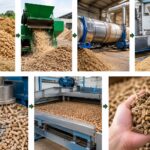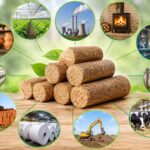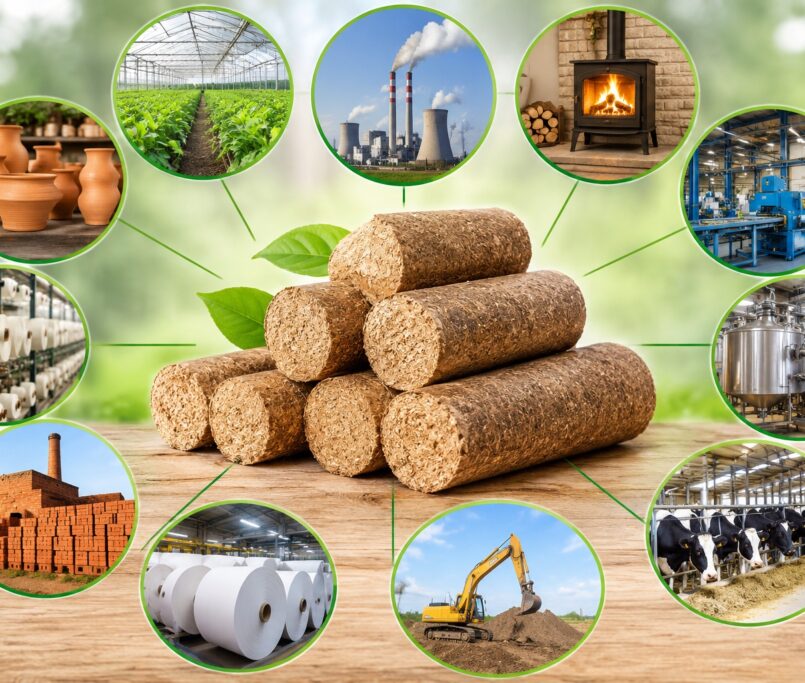

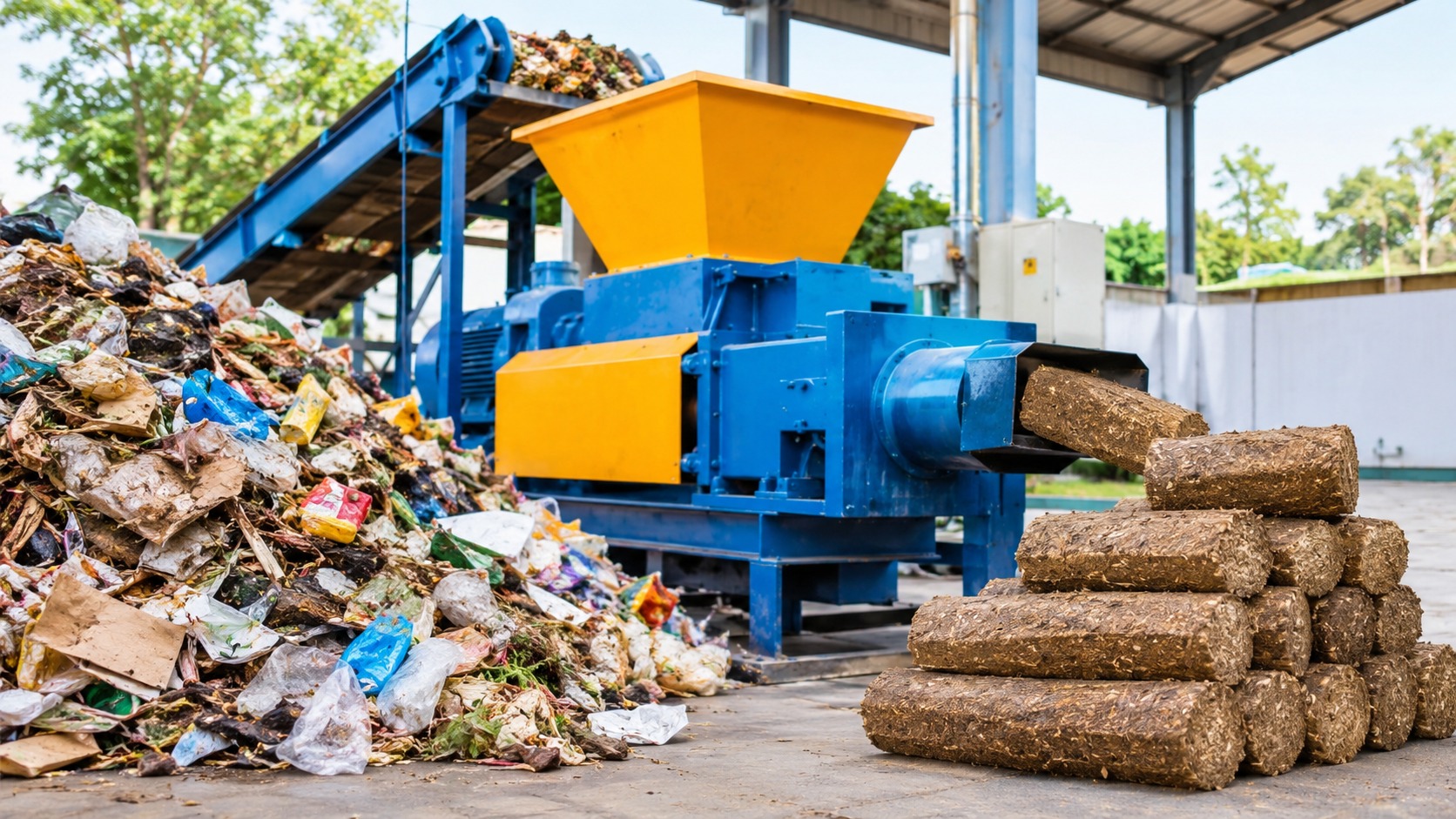
The municipal solid waste briquetting process involves collecting, sorting, separating, shredding, flash drying, and compressing suitable combustible waste into solid fuel. This process can convert certain non-recyclable waste fractions into refuse-derived fuel (RDF) briquettes or other fuel forms for approved industrial applications.
Municipal solid waste (MSW) includes household, commercial, market, and institutional waste. However, not all collected waste can be used as fuel. Recyclable materials, hazardous waste, batteries, glass, metals, and unsuitable wet organic waste must be separated before processing.
For biomass business owners in Rajkot, India, waste-to-fuel technology offers an opportunity to explore alternative fuel production using properly processed waste. Understanding the complete process, machinery requirements, and fuel quality standards is essential before starting such a project.
What Is Municipal Solid Waste Briquetting?
Municipal solid waste briquetting is a process of converting the suitable combustible fraction of municipal waste into compact solid fuel.
The process generally involves recovering non-recyclable combustible materials, removing unwanted substances, reducing particle size, controlling moisture, and compressing the prepared material.
The resulting fuel is commonly called refuse-derived fuel (RDF). Depending on the feedstock and technology, it can be produced in different forms, including:
- RDF briquettes
- RDF pellets
- Refuse-derived fuel fluff
- Compressed waste fuel blocks
Unlike conventional biomass briquettes made from agricultural residues, RDF briquettes may contain a mixture of suitable combustible waste fractions. Their composition and quality must be tested before industrial use.
Why is municipal waste converted into fuel?
The main objectives include:
- Recovering energy from suitable combustible waste.
- Reducing the amount of residual waste sent to landfills.
- Supporting resource recovery and circular economy practices.
- Producing alternative fuel for approved industrial applications.
- Improving waste management through scientific processing.
What Types of Municipal Waste Can Be Used to Make Fuel Briquettes?
Not every type of municipal waste is suitable for fuel production. The waste must first be separated according to its material type, recycling potential, safety, and fuel characteristics.
Suitable combustible waste fractions
The following materials may be considered for RDF production after proper sorting and quality assessment.
|
Waste Material |
Potential Use |
|
Non-recyclable paper |
Combustible fuel fraction |
|
Contaminated cardboard |
Fuel preparation after recovery assessment |
|
Textile waste |
Suitable combustible fraction |
|
Non-recyclable packaging |
RDF feedstock after material assessment |
|
Selected non-recyclable plastics |
RDF feedstock subject to strict quality and emission controls |
|
Dry wood waste |
Combustible material |
|
Other suitable dry combustible residues |
Fuel preparation after testing |
Which waste materials should be excluded?
The following materials should not be mixed into the fuel feedstock:
- Glass and stones.
- Metals and aluminium.
- Batteries and electronic waste.
- Biomedical and sanitary waste.
- Hazardous chemical containers.
- Paint, pesticide, and chemical waste.
- PVC-rich and other unsuitable chlorinated materials.
- Wet biodegradable waste intended for composting or biomethanation.
Important: Under India’s Solid Waste Management Rules, 2026, waste is segregated into four streams: wet waste, dry waste, sanitary waste, and special care waste. Recycling and recovery should be prioritised, and waste should be sent to the appropriate authorised processing channel.
Press Information Bureau+1
What Are the Steps Involved in Municipal Solid Waste Briquetting?
The municipal solid waste briquetting process requires multiple processing stages. Each stage helps prepare suitable combustible waste for conversion into fuel.
Step 1: Waste collection and segregation
The first step is collecting municipal waste from authorised sources such as households, commercial areas, markets, and institutions.
Waste must be separated before processing to recover recyclable materials and identify suitable combustible fractions.
Important activities include:
- Collecting waste through authorised channels.
- Separating wet and dry waste.
- Recovering recyclable materials.
- Removing hazardous and special-care waste.
- Identifying suitable combustible materials.
Step 2: Waste sorting and preprocessing
Preprocessing is one of the most important stages of waste-to-fuel production.
The collected dry waste is passed through suitable sorting equipment to remove unwanted materials.
Common municipal solid waste preprocessing methods include:
- Manual sorting.
- Mechanical screening.
- Magnetic separation.
- Air classification.
- Removal of glass and stones.
- Recovery of recyclable materials.
These methods help improve the consistency of the combustible fraction and reduce contamination.
Step 3: Shredding and size reduction
After sorting, suitable combustible waste is sent to a shredding machine.
The machine reduces large waste materials into smaller and more uniform pieces.
Benefits of shredding include:
- Better material handling.
- More consistent particle size.
- Improved feeding into subsequent equipment.
- Easier drying and blending.
- Better preparation for fuel densification.
The required particle size depends on the briquetting machine and the characteristics of the feedstock.
Step 4: Drying and moisture control
Moisture affects fuel quality, storage, and processing efficiency. Therefore, the prepared combustible material may require drying before densification.
A suitable industrial dryer can help reduce excess moisture.
Common drying options include:
- Rotary drum dryer.
- Hot-air drying system.
- Other suitable industrial drying arrangements.
The required moisture level should be determined through feedstock testing and the specifications of the intended fuel-making equipment.
Step 5: Material blending and quality checking
Before briquetting, the prepared material should be checked for consistency.
Important parameters include:
- Moisture content.
- Particle size.
- Ash content.
- Calorific value.
- Chlorine content.
- Sulphur content.
- Bulk density.
Blending may be required to achieve more consistent fuel characteristics. However, adding materials simply to increase calorific value should never replace proper quality and emissions testing.
Step 6: Briquetting and compression
After preprocessing and quality checks, suitable material can be fed into a compatible briquetting system.
The machine applies mechanical pressure to compress the prepared feedstock into a compact fuel form.
The briquetting stage may involve:
- Feeding prepared material into the machine.
- Applying the required compression.
- Forming compact fuel blocks.
- Discharging the finished product.
- Checking the shape, density, and strength.
Equipment compatibility is critical: A conventional biomass briquetting machine designed for clean agricultural residues may not be suitable for mixed RDF feedstock. The machine must be tested and specified for the actual waste composition.
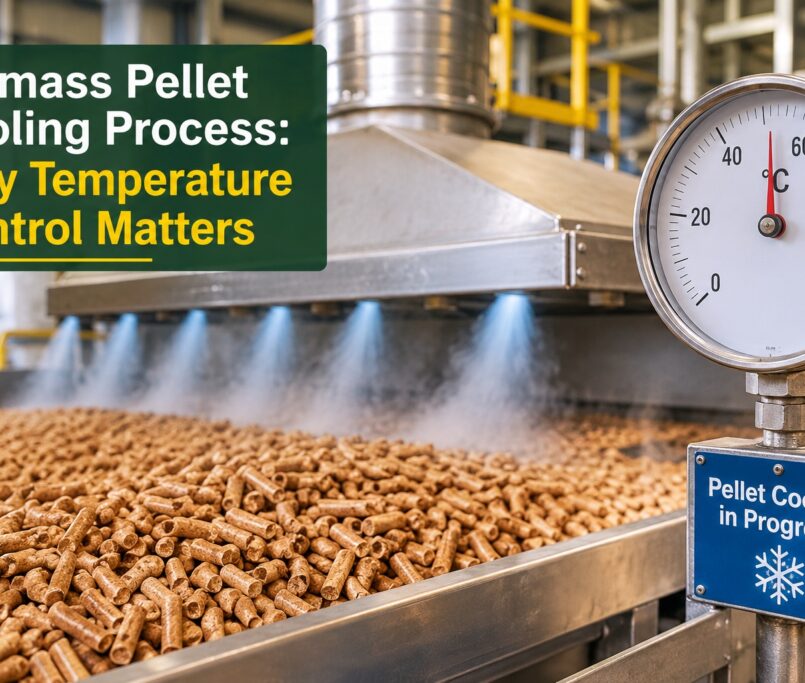
Step 7: Cooling, storage, and packaging
After compression, the fuel product may need cooling and stabilisation, depending on the production system.
The final product should be:
- Stored in a dry and covered area.
- Protected from moisture.
- Kept away from ignition sources.
- Labelled according to its fuel characteristics.
- Tested before dispatch to industrial users.
Proper storage helps maintain fuel quality and reduces handling risks.
Which Machines Are Required for Municipal Solid Waste Briquetting?
A waste-to-fuel production plant requires several machines to process and prepare municipal waste. The equipment depends on the type of waste, daily processing capacity, and final fuel requirements.
|
Machinery |
Main Function |
|
Waste sorting conveyor |
Separates different waste materials |
|
Trommel screening machine |
Separates waste according to size |
|
Magnetic separator |
Removes ferrous metals |
|
Air classifier |
Separates lighter and heavier materials |
|
Industrial shredder |
Reduces waste particle size |
|
Biomass or RDF dryer |
Reduces excess moisture |
|
Mixing system |
Creates a more uniform feedstock |
|
Briquetting machine |
Compresses prepared material into fuel briquettes |
|
Dust collection system |
Controls dust during processing |
How does each machine support fuel production?
The sorting conveyor and screening equipment prepare the waste for further processing. Shredders reduce material size, while dryers control moisture.
Finally, a compatible briquetting machine compresses the prepared combustible fraction into solid fuel.
The machinery should be selected as one integrated production line rather than as separate machines without checking their compatibility.
What Are the Benefits of Converting Municipal Waste into Fuel Briquettes?
Converting suitable municipal waste into fuel can support waste recovery and industrial fuel production.
Some important benefits include:
1. Better waste resource recovery
Suitable combustible waste that cannot be economically recycled may be processed into RDF instead of being sent directly to landfill.
2. Alternative industrial fuel
Properly prepared RDF can be used as an alternative fuel in approved industrial facilities, subject to fuel quality and pollution-control requirements.
3. Reduced landfill dependency
Recovering suitable combustible waste can reduce the volume of residual waste requiring disposal.
4. Support for circular economy practices
Waste-to-fuel processing can help recover value from selected waste materials and support more efficient resource use.
5. Business opportunities
Waste processing businesses may explore opportunities in:
- RDF manufacturing.
- Waste preprocessing services.
- Industrial fuel supply.
- Waste management partnerships.
- Waste recovery infrastructure.
However, business profitability depends on waste availability, processing costs, transport, fuel quality, permissions, and the demand from industrial users.
What Factors Affect the Quality of Municipal Waste Fuel Briquettes?
The quality of the final fuel depends on the materials used and how they are processed.
|
Quality Factor |
Why It Matters |
|
Calorific value |
Indicates the amount of heat produced |
|
Moisture content |
Affects heating performance and storage |
|
Ash content |
Influences residue after combustion |
|
Particle size |
Affects feeding and compression |
|
Chlorine content |
Important for corrosion and emission control |
|
Sulphur content |
Important for combustion emissions |
|
Density |
Influences storage and transportation |
|
Mechanical strength |
Helps reduce breakage during handling |
According to technical guidance from India’s Central Pollution Control Board, waste characteristics such as moisture content and calorific value are important when selecting waste-processing technologies.
A fuel sample should be tested in an appropriate laboratory before it is supplied to industrial customers.
Is Municipal Solid Waste Briquetting Suitable for Businesses in Rajkot, India?
Rajkot is an established industrial location in Gujarat, and businesses interested in alternative fuel production can explore opportunities in waste processing and resource recovery.
For entrepreneurs in Rajkot, India, municipal waste fuel production requires more than purchasing a briquetting machine.
Before starting, consider:
- Availability of properly segregated municipal dry waste.
- Agreements with authorised waste collection agencies.
- Access to a material recovery facility.
- Availability of suitable combustible feedstock.
- Transportation and storage costs.
- Machinery installation and operating expenses.
- Testing facilities for fuel quality.
- Industrial buyers and end-use requirements.
- Environmental permissions and regulatory compliance.
What permissions and regulations should businesses consider?
India’s Solid Waste Management Rules, 2026, came into force on 1 April 2026, replacing the 2016 rules. They establish updated requirements for waste segregation, collection, processing, and reporting.
Press Information Bureau+1
Businesses planning an MSW processing or RDF manufacturing facility should check the applicable requirements with:
- Local municipal authorities.
- Gujarat Pollution Control Board (GPCB).
- Central Pollution Control Board (CPCB), where applicable.
- Relevant environmental and industrial authorities.
The required registration, authorisation, environmental clearances, and operating conditions depend on the proposed facility and activity. Do not start processing mixed municipal waste without confirming the applicable approvals.
How Can Shree Khodiyar Engineering Works Support Biomass Processing Businesses?
Selecting suitable machinery is an important part of building an efficient biomass and waste-processing facility.
Shree Khodiyar Engineering Works can be positioned as a machinery partner for businesses exploring biomass processing and fuel manufacturing equipment.
Before choosing a machine, businesses should discuss:
- Type of feedstock.
- Daily processing requirement.
- Material moisture content.
- Required particle size.
- Desired fuel shape and density.
- Available factory space.
- Machinery compatibility.
- Maintenance and technical support.
For municipal solid waste projects, the engineering team should first assess whether the proposed feedstock is suitable for the offered equipment. A trial using representative processed material is advisable before finalising the machinery.
This approach helps businesses avoid purchasing equipment that cannot handle their actual feedstock.
What Is the Difference Between Biomass Briquettes and RDF Briquettes?
Although both products are compressed solid fuels, their raw materials and processing requirements can be different.
|
Comparison |
Biomass Briquettes |
RDF Briquettes |
|
Raw material |
Agricultural and forestry residues |
Suitable combustible municipal waste fractions |
|
Examples |
Sawdust, groundnut shells, rice husk |
Selected dry paper, textiles and non-recyclable combustible packaging |
|
Processing |
Drying, grinding and compression |
Sorting, recycling recovery, shredding, drying and densification |
|
Contamination |
Generally low when feedstock is clean |
Requires strict contamination control |
|
Fuel quality |
Depends on biomass properties |
Depends on mixed waste composition |
|
Main consideration |
Moisture and ash content |
Moisture, ash, chlorine, sulphur and calorific value |
Important distinction: RDF is not automatically the same as conventional biomass briquettes. Its suitability depends on feedstock composition, fuel testing, and the requirements of the industrial end user.
Conclusion: How to Convert Municipal Solid Waste into Biomass Briquettes?
The municipal solid waste briquetting process provides a way to recover energy from selected non-recyclable combustible waste. The process involves waste collection, segregation, preprocessing, shredding, drying, quality testing, and briquetting.
However, successful fuel production depends on using suitable feedstock and following proper waste management practices. Recyclable, hazardous, wet organic, and unsuitable materials must be directed to their appropriate treatment channels.
For biomass business owners in Rajkot, India, waste-to-fuel technology can offer an opportunity to explore alternative fuel production and resource recovery.
Shree Khodiyar Engineering Works encourages businesses to understand their raw material requirements, production capacity, and machinery compatibility before investing in fuel manufacturing equipment.
Frequently Asked Questions (FAQs)
1. What types of municipal waste can be used to make fuel briquettes?
Suitable combustible fractions may include non-recyclable paper, cardboard, textiles, selected non-recyclable plastics, and dry wood waste. These materials must be properly sorted, assessed, and tested before fuel production.
2. What are the steps involved in municipal solid waste briquetting?
The main steps are waste collection, segregation, sorting, shredding, drying, blending, quality testing, briquetting, cooling, and storage.
3. Which machines are used in municipal solid waste briquetting?
Common equipment includes sorting conveyors, trommel screens, magnetic separators, air classifiers, industrial shredders, dryers, mixing systems, briquetting machines, and dust collection systems.
4. Can all municipal solid waste be converted into fuel briquettes?
No. Municipal solid waste contains recyclable, biodegradable, hazardous, and non-combustible materials. Only suitable combustible fractions should be considered for RDF production after proper segregation and testing.
5. What is the difference between RDF and biomass briquettes?
Biomass briquettes are generally manufactured from agricultural and forestry residues, such as sawdust and rice husk. RDF is produced from selected combustible fractions of municipal and other suitable waste streams.