
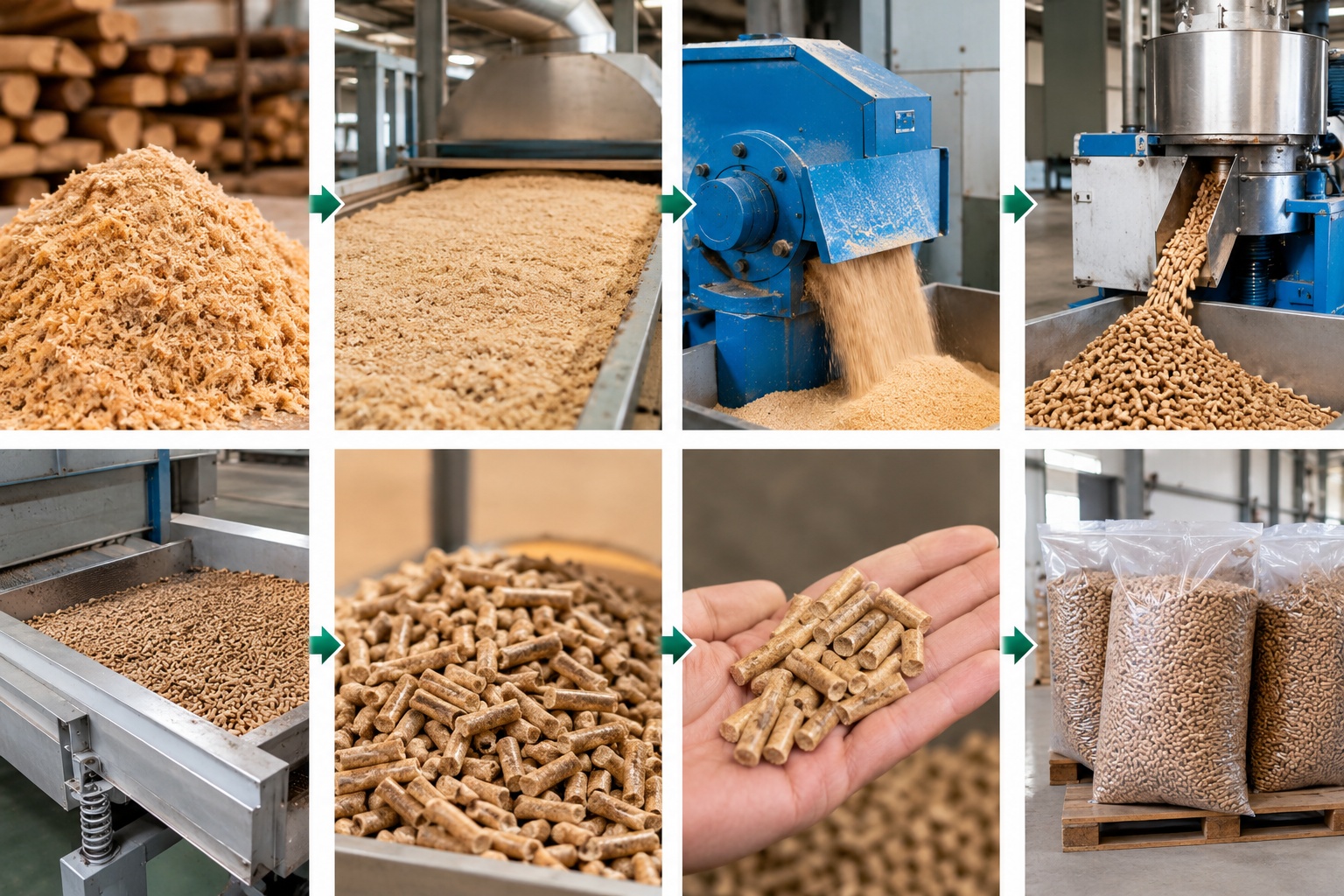
Wood pellets are compact fuel products made by compressing prepared wood materials into small, uniform cylinders. To understand how to make wood pellets from sawdust, manufacturers need to prepare suitable raw materials, control moisture, reduce particle size, use the correct pellet machine, and check the quality of the finished product.
For biomass business owners, sawdust pellet production can provide a way to convert suitable wood-processing waste into a marketable fuel. However, production quality depends on the raw material, machinery, operating conditions, energy costs, and customer requirements.
In Rajkot, India, entrepreneurs exploring biomass processing should evaluate local raw-material availability and potential buyers before investing in a production line. This guide explains the wood pellet manufacturing process, the equipment required, and the practical steps involved in producing consistent pellets.
What Is the Process of Making Wood Pellets from Sawdust?
The process of making wood pellets from sawdust involves seven main stages: raw-material selection, screening, size reduction, drying, pelletizing, cooling, and quality inspection.
The exact process depends on the type of wood, initial moisture content, pellet specifications, and production capacity.
A typical wood pellet manufacturing process follows these steps:
- Collect suitable sawdust and other approved wood residues.
- Remove contaminants and inspect the raw material.
- Grind or screen the material to obtain a suitable particle size.
- Dry the material to the moisture level required by the equipment.
- Feed the prepared sawdust into a wood pellet machine.
- Cool and stabilize the newly produced pellets.
- Screen, test, package, and store the finished pellets.
Each stage helps maintain production consistency and reduce avoidable material losses.
Which Wood Pellet Raw Materials Are Suitable for Production?
Choosing the right wood pellet raw materials is the first step toward reliable production. Clean sawdust from suitable woodworking and sawmilling operations is a common feedstock.
Other potential materials include:
- Hardwood sawdust
- Softwood sawdust
- Wood shavings
- Clean wood-processing residues
- Suitable untreated wood chips after size reduction
Not every wood residue is suitable for every pellet application. Material characteristics, customer specifications, and applicable regulations must be considered before processing.
How do hardwood and softwood sawdust differ?
Hardwood and softwood sawdust can behave differently during pelletizing because their density, fiber structure, and natural binding characteristics vary.
Some feedstocks form durable pellets more easily than others. The results also depend on particle size, moisture, die temperature, machine settings, and other operating conditions.
Businesses should test their chosen raw materials before planning large-scale production.
Important: Avoid contaminated wood and materials containing paint, preservatives, adhesives, or other unsuitable chemicals unless their use is specifically permitted for the intended application.
How to Prepare Sawdust Before Making Wood Pellets
Knowing how to prepare sawdust before making wood pellets helps manufacturers improve feed consistency and reduce processing problems.
Step 1: Inspect and clean the sawdust
Start by checking the incoming sawdust for stones, metal fragments, plastic, soil, and other unwanted materials.
Use suitable screening and separation methods to remove contaminants. Metal detection or separation equipment may also be appropriate, depending on the raw-material source and plant design.
Clean material helps protect machinery and improves process reliability.
Step 2: Reduce the particle size
Sawdust may already have a suitable particle size, but some feedstocks require additional grinding or screening.
A hammer mill or other suitable size-reduction machine can prepare material for the pelletizing stage. The target particle size should match the pellet machine manufacturer’s specifications and the required finished product.
Material that is too coarse or inconsistent can cause feeding problems and affect pellet formation.
Step 3: Measure the moisture content
Moisture content is one of the most important factors in sawdust pellet production.
Material that is too wet may produce soft pellets, require additional drying, or create operating difficulties. Material that is too dry may also affect pellet formation, depending on the feedstock and machine.
The required moisture level varies by raw material and equipment. Many wood pellet processes use feedstock moisture in the approximate range of 8–15%, but this is not a universal specification. Follow the machine manufacturer’s guidance and confirm the correct level through testing.
Step 4: Dry the material when required
If the sawdust has excessive moisture, use an appropriate drying method before pelletizing.
Depending on the scale and production requirements, this may involve controlled natural drying or an industrial biomass dryer.
When selecting a dryer, consider the initial moisture content, target moisture, throughput, available energy, operating costs, and safety requirements.
What Machinery Is Required for Sawdust Pellet Production?
A wood pellet manufacturing line may require several machines, depending on the condition of the raw material and the planned production capacity.
|
Equipment |
Main purpose |
|
Screening equipment |
Removes unwanted particles and separates material by size |
|
Hammer mill |
Reduces particle size when additional grinding is needed |
|
Biomass dryer |
Reduces excessive moisture |
|
Conveyor system |
Moves material between processing stages |
|
Sawdust pellet machine |
Compresses prepared material into pellets |
|
Cooling system |
Helps pellets cool and stabilize after production |
|
Screening unit |
Removes loose fines from finished pellets |
|
Packaging equipment |
Prepares pellets for storage and distribution |
Not every plant needs every machine. For example, already-clean sawdust with suitable particle size may require less preparation than mixed wood residues.
How does a sawdust pellet machine work?
A sawdust pellet machine uses mechanical pressure to compress prepared material through openings in a die. Depending on the machine design, rollers force the material through the die to form cylindrical pellets.
Heat generated during compression and the natural binding characteristics of the wood help particles hold together. The pellets are then cut to the required length.
The machine must be matched to the feedstock, intended output, operating conditions, and product specifications. Buyers should evaluate actual performance on their chosen material instead of relying only on advertised capacity.
Step-by-Step Wood Pellet Manufacturing Process
Step 5: Feed the prepared sawdust into the pellet machine
Once the material meets the required preparation specifications, feed it into the pelletizing system at a controlled rate.
Consistent feeding helps maintain stable operation. Sudden changes in moisture, particle size, or feed volume may affect output and pellet quality.
Follow the machine manufacturer’s instructions for startup, adjustment, lubrication, and safe operation.
Step 6: Form the pellets
During pelletizing, the machine compresses sawdust through the die to form small cylindrical pellets.
Production performance depends on several factors:
- Feedstock type and composition
- Moisture content
- Particle-size consistency
- Die and roller condition
- Feeding rate
- Machine settings and operating temperature
If pellets are weak, irregular, or difficult to form, investigate the feedstock and operating conditions before changing equipment or adding unnecessary binders.
Step 7: Cool and screen the pellets
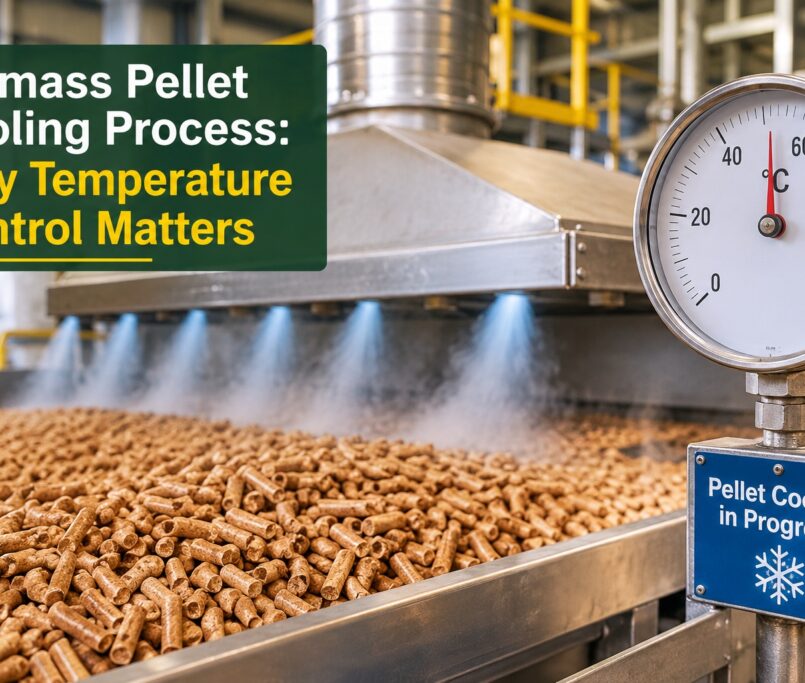
Freshly produced pellets can be warm and relatively fragile. Allow them to cool and stabilize using a suitable cooling arrangement before packaging.
Screening removes loose fines and broken particles. Depending on the plant design, these fines may be returned to the production process when appropriate.
Cooling and screening help improve the consistency of the final product during handling and transportation.
Step 8: Check pellet quality
Before dispatch, inspect the pellets against the specifications agreed with customers.
Important quality checks include:
- Moisture content: Helps assess storage suitability and fuel quality.
- Durability: Indicates how well pellets resist breaking during handling.
- Dimensions: Confirms that pellet size meets customer requirements.
- Ash content: Helps assess the amount of residue left after combustion.
- Calorific value: Measures the energy released during combustion.
- Fines content: Indicates the amount of loose or broken material.
The required limits depend on the intended application and applicable fuel standards. Businesses supplying industrial customers should test products against the relevant specifications rather than assuming that all pellets meet the same requirements.
What Problems Can Occur During Sawdust Pellet Production?
Even a well-planned production line can experience problems if raw-material conditions or machine settings change.
|
Common problem |
Possible cause |
Recommended action |
|
Weak or crumbly pellets |
Unsuitable moisture, particle size, or compression conditions |
Test the material and adjust the process according to manufacturer guidance |
|
Irregular pellet size |
Inconsistent feeding or cutting conditions |
Check feed consistency and cutting equipment |
|
Excessive fines |
Poor pellet durability or rough handling |
Review pellet quality, cooling, and handling |
|
Machine blockages |
Contaminants, unsuitable feed, or incorrect operation |
Stop safely and inspect the cause |
|
High drying costs |
Wet incoming sawdust |
Improve moisture management and evaluate drying efficiency |
|
Inconsistent production |
Changes in feedstock quality |
Standardize incoming material checks and operating procedures |
Routine maintenance, operator training, and production records can help identify recurring issues before they lead to extended downtime.
How Much Sawdust Is Needed to Produce Wood Pellets?
The amount of sawdust required depends on the moisture content of the raw material, processing losses, rejected material, and the desired finished output.
For example, suppose a manufacturer wants to produce one tonne of pellets from sawdust containing 30% moisture, while targeting pellets with 10% moisture. Assume that dry wood solids are conserved and there are no other processing losses.
The dry solids in the incoming material are:
1,000 kg × (1 − 0.30) = 700 kg of dry solids.
To produce material containing 10% moisture, the theoretical finished mass would be:
700 kg ÷ (1 − 0.10) = approximately 778 kg.
This simplified example shows why raw-material moisture matters when calculating production yield. Actual output and input requirements will vary with the feedstock, processing losses, and product specifications.
Before estimating plant capacity or profitability, businesses should measure their raw-material moisture and run production trials.
How Can Biomass Businesses Make Sawdust Pellet Production More Efficient?
For biomass business owners, production efficiency involves more than selecting a high-capacity machine. The complete process must operate reliably and at a commercially reasonable cost.
Consider these practices:
- Secure a consistent supply: Establish relationships with reliable sawmills and woodworking businesses.
- Control raw-material quality: Inspect incoming material and record moisture levels.
- Manage drying costs: Compare dryer energy consumption and performance under actual operating conditions.
- Maintain equipment: Follow preventive maintenance schedules and inspect wear parts.
- Monitor production data: Record input quantity, finished output, fines, downtime, and energy consumption.
- Understand buyer requirements: Confirm pellet dimensions, moisture, durability, ash content, and other required specifications.
- Calculate the complete production cost: Include raw materials, labor, electricity, drying, maintenance, packaging, transportation, and overheads.
In Rajkot, India, entrepreneurs planning a wood pellet business should assess regional feedstock availability, transport costs, industrial demand, and the suitability of their chosen equipment before investing.
How Can Shree Khodiyar Engineering Works Help with Biomass Processing?
Shree Khodiyar Engineering works in the biomass briquetting and processing machinery sector. Businesses exploring sawdust pellet production should first define their raw material, target output, finished-product specifications, and budget.
It is important to distinguish between briquetting and pelletizing. Briquetting machines produce larger compressed fuel pieces, while pellet machines manufacture smaller pellets through a suitable die system. The two processes have different equipment and operating requirements.
Before selecting machinery, discuss the following details with the supplier:
- Type and source of sawdust
- Initial moisture content
- Required finished-product dimensions
- Target production capacity
- Available power supply
- Drying and material-handling requirements
- Quality specifications for the intended customer
Shree Khodiyar Engineering Works can be a starting point for exploring biomass processing machinery and discussing equipment requirements. Confirm the availability of specific pelletizing equipment, capacity, and configuration directly with the company before making an investment decision.
Conclusion
Learning how to make wood pellets from sawdust involves understanding the complete process, from raw-material preparation to finished-product testing. Clean sawdust, controlled moisture, suitable particle size, compatible pelletizing equipment, and proper cooling all contribute to consistent production.
For biomass business owners, the best approach is to assess raw-material availability, conduct practical production trials, and calculate operating costs before choosing a machine or finalizing plant capacity.
With careful planning, suitable machinery, and regular quality checks, sawdust can become a useful feedstock for producing wood pellet that meet the requirements of compatible fuel applications.
Frequently Asked Questions About Sawdust Pellet Production
1. Can wood pellets be made from ordinary sawdust?
Yes, suitable clean sawdust can be used to make wood pellets. The material may require screening, grinding, or drying before it can be processed efficiently.
2. What is the ideal moisture content for making wood pellets?
The required moisture content depends on the feedstock and pellet machine. A range around 8–15% is used in many processes, but the correct target should be confirmed through equipment guidance and material testing.
3. Which machine is used to make wood pellets from sawdust?
A wood pellet machine or pellet mill compresses prepared sawdust into pellets. A larger production line may also require a hammer mill, dryer, conveyors, cooler, screening equipment, and packaging machinery.
4. Why do sawdust pellets break easily?
Weak pellets may result from unsuitable moisture, inconsistent particle size, incorrect machine settings, worn components, or unsuitable feedstock. Check these factors before changing the production process.
5. Is sawdust pellet manufacturing suitable for a small business?
It may be suitable if the business can secure reliable raw materials, identify customers, meet fuel quality requirements, and manage machinery and operating costs. A feasibility study and production trial are recommended before investment.